

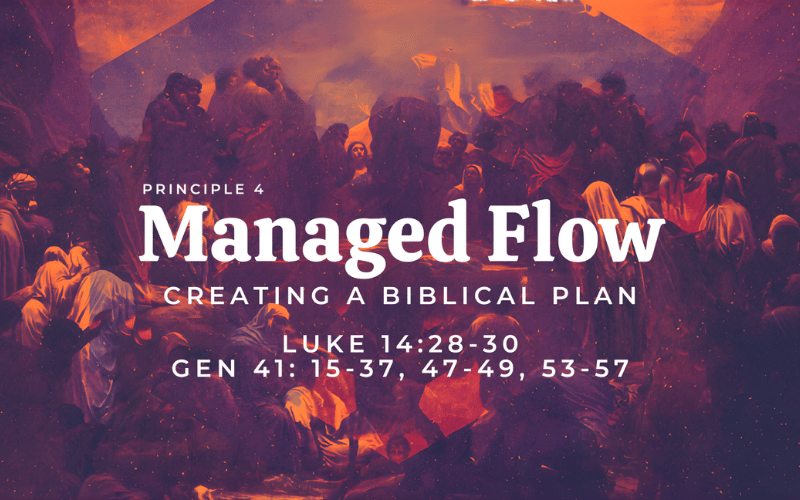
What does it actually look like to plan your finances with God at the center? Drawing from Luke 14 and the story of Joseph in Genesis 41, there is a practical, biblical framework for building a plan that positions you for the future God has in mind. This is not about controlling outcomes. It is about stewarding what you have been given and trusting God to do what only He can do.
Why Jesus Talked About Counting the Cost
In Luke 14:28-30, Jesus tells a simple but pointed story about a man building a tower. He says, “But don’t begin until you count the cost. For who would begin construction of a building without first calculating the cost to see if there’s enough money to finish it? Otherwise, you might complete only the foundation before running out of money, and then everyone would laugh at you.”
The problem Jesus is addressing is not the foundation. It is the finish. Many people start with good intentions, take a few steps, and then stall out. Jesus wants us to finish what we start, and that requires a plan built around the outcome, not just the beginning.
Jesus said He came so that we might have life in all its fullness. Accepting anything less than that is accepting less than what He died to give us. And that applies to every area of life, including finances.
Is There Really a Difference Between Spiritual and Secular Life?
One of the most important shifts in thinking is this: for a believer, there is no such thing as spiritual versus secular. You are a Spirit who has a soul and lives in a body. That means your work is spiritual. Your marriage is spiritual. Your finances are spiritual. All of it matters to God.
When we divide life into spiritual and non-spiritual categories, we end up operating from a place of fear and bondage rather than from the freedom that comes through relationship with God. The goal is not balance between work and life. It is alignment, bringing every dimension of your life into line with God’s purpose.
What Is the Tower Model for Biblical Planning?
The Tower Model is a six-step framework drawn from Luke 14 and seen throughout Scripture. Here are the six components:
- Envision: What am I building and why?
- Count: What is it going to take to build it?
- Assess: What do I already have?
- Identify: What is the gap between what I have and what I need?
- Action: What am I going to do?
- Measure: How am I tracking progress along the way?
This model is not just for finances. It can be applied to marriage, business, ministry, or any area where you are trying to build something that honors God.
What Can We Learn from Joseph’s Plan in Genesis 41?
Genesis 41 gives us one of the most remarkable examples of Spirit-led planning in all of Scripture. Joseph interpreted Pharaoh’s dream and revealed that seven years of abundance would be followed by seven years of severe famine. Then he did not just deliver the message. He delivered a plan.
Joseph said in Genesis 41:33-36 that Pharaoh should find a wise man to oversee the land, appoint supervisors to collect one fifth of all crops during the good years, and store that grain so there would be food when the famine came.
Joseph had a word from God and a plan from God. One without the other would not have been enough. A biblical plan is not a desire you ask God to bless. It is a plan developed under His purpose, His wisdom, and His direction.
How Do You Assess What You Already Have?
The third step in the Tower Model is to assess. This is where most people get it backwards. Instead of starting with what they do not have, a God-centered plan starts with what you do have.
Think about the widow in 2 Kings who came to the prophet in desperation. Her husband had died, debt had mounted, and creditors were threatening to take her sons. When the prophet asked what she had, she said she had nothing except a little oil. And God used that little bit of oil to fill vessel after vessel until she had enough to pay off her debt and live on the rest.
God always starts with what is already in your hand. He put a slingshot in David’s hand. He put oil in the widow’s hand. He put grain in Egypt’s fields. Every story in Scripture shows God taking what seemed insignificant and teaching people to use it in a different way.
As Philippians 4:19 reminds us, “My God shall supply all your need according to His riches in glory by Christ Jesus.” You may not have everything you need yet. But God can turn what you do have into everything you need.
What Should You Actually Inventory When Assessing Your Finances?
A good plan requires a good inventory. Here are some honest questions to work through:
- What comes in and what goes out?
- What is it coming in for and what is it going out for?
- What do I own and what do I owe? (This is your net worth.)
- What do I have and what is its condition?
- What is its purpose and what is its potential?
- What is producing something in my life and what is consuming something?
- What is my seed and what is my bread?
Never measure your self-worth by your net worth. But always know your net worth.
How Do You Identify the Gap Without Getting Discouraged?
The fourth step is to identify the gap. This is not about focusing on what you lack. It is about finding the distance between where you are and where you need to be, and then asking God what His plan is for that space.
Proverbs 15:22 says, “Plans lack counsel, but they succeed with good advice.” And Proverbs 20:18 says, “His plans are established through counsel.” Good counsel helps you see the gap that enthusiasm, fear, or discouragement causes you to overlook. Someone outside your situation can often see the potential and the path more clearly than you can from the inside.
Joseph identified that Egypt would need 20 percent of each year’s harvest set aside consistently over seven years. He did not say everyone would have to suffer through the good years to prepare for the bad ones. He said they would live well and plan wisely at the same time. Today’s surplus can become tomorrow’s supply.
Can You Control the Future with a Good Plan?
No. And that is not the point. Egypt could not avoid the famine. But they could avoid what the famine would have created if they had not prepared. You cannot control the rain, but you can control the rain barrels.
A good plan under God’s direction does not mean bad things will not happen. It means God has a plan to make all things work together for good, even in the hard seasons. Romans 8:28 is not just a comfort verse. It is a planning principle.
Ecclesiastes 3:11 tells us that God has divided time into seasons, and every season has a purpose. God does not fill time with purpose. He assigns a purpose and then fills it with time. Discerning the purpose of your current season is part of building a wise plan.
What Happens When You Commit Your Plan to God?
The Bible says that during those seven years of plenty, Egypt had bumper crops so abundant that they stopped counting because there was too much to measure. God blessed the plan. Proverbs 16 tells us that if you commit your ways to the Lord, He will make your plans succeed.
When you make a God plan, He makes a God way. It may not make sense to others. People may doubt it. You may doubt it yourself. But when God touches something that is void and without form, He brings it into order. He makes it something beautiful.
As Philippians 1:6 reminds us, “He who has begun a good work in you will carry it on to completion until the day of Christ Jesus.” If He is able to finish it, so are you, when you walk with Him.
Life Application
This week, take one practical step toward assessing what God has already placed in your hands. Sit down and write out what comes in and what goes out. List what you own and what you owe. Identify at least one resource, whether it is money, a skill, a relationship, or an opportunity, that you may not be using toward the future God has for you.
Then pray over it. Ask God to show you how to use what you have in a different way. You do not need to have everything figured out. You just need to start with what is already in your hand.
Ask yourself these questions as you reflect:
- Am I living an income-based life, focused on what I do not have, or an outcome-based life, starting with what God has already given me?
- What area of my life am I treating as separate from God’s involvement, when He actually wants to be part of it?
- Is there a gap between where I am and where I believe God wants me to be? What is one step I can take this week to begin closing that gap?
- Am I using today’s surplus to supply tomorrow, or am I spending everything I have on increasing my lifestyle?
God has a plan for your life. He has already placed something in your hands to begin building toward it. The question is whether you will assess it, commit it to Him, and trust Him to do what only He can do with it.